FITZROY, CHIPCHASE and CHARLES DIBDIN

Fitzroy, Chipchase and Charles Dibdin
Thursday, March 13, 2008
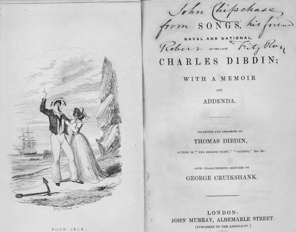
Charles Dibdin (1745-1814) was a famous British musician, dramatist, novelist, actor, and songwriter, known among other things for introducing a new kind of one-man-show -- musical variety entertainments called The Oddities and The Whim of the Moment, at Fisher's Auction Room in King Street (Covent Garden). In these he introduced many songs of marked popularity, including "Poor Jack," "'Twas in the good ship 'Rover'," "Saturday Night at Sea," and "I Sailed from the Downs in the 'Nancy.'" The immortal song "Tom Bowling" was written on the death of his eldest brother, Captain Thomas Dibdin, at whose invitation he had planned his visit to India. His songs, music and recitations permanently established his fame as a lyric poet.
Dibdin's patriotic sea-songs (painting the simple loyalty and manly courage of the British sailor) and their melodious refrains powerfully influenced the national spirit and were officially appropriated to the use of the British navy during the war with France.
This collection of his songs, in my posession, is inscribed by Robert Fitzroy, the Captain of the H.M.S. Beagle, to “his friend”, John Chipchase.
Who was John Chipchase?
In his book Fitzroy of the Beagle, H.E.L. Mellersh writes a chapter entitled “The Disgraceful Episode.” It describes Fitzroy’s candidature in 1841 for a seat in the House of Commons. He would have been a shoe-in for the Tory seat for the County of Durham, had it not been for young man (age twenty-six) by the name of William Sheppard, who also decided to run for the seat.
Fitzroy’s maternal uncle, Lord Londonderry, had been pulling strings for him. One of the wealthy Londonderry’s tenants spoke up publicly and stated that he had been ordered by his landlord to vote for Fitzroy and not for Sheppard. Fitzroy denied this most vehemently, but the word began to travel that Londonderry was pulling strings for Fitzroy.
Sheppard, realizing the fix was in, suddenly withdrew his candidature, stating to Fitzroy that he must do so and denounce Lord Londonderry. Fitzroy did not take this as an honorable act -- as he felt it might not only imperil his candidacy, but also stain his honor by airing such dirty laundry in public. He made a speech calling Sheppard’s withdrawal a ‘disgraceful desertion’, and ‘an event unparalleled in the annals of electioneering.’ Soon, the two began exchanging a series of increasingly disparaging letters.
Mellersh writes:
“At the mention of the word ‘honor’ the damage was done. Sheppard at once sought out a second, a Lieutenant Colonel Pringle Taylor, who ascertained that his opposite number would be a certain Major Chipchase, and wrote to that gentleman requesting that he would name a time and a place where the question between protagonists could ‘be brought to issue.’ The days of dueling by the aristocracy were not yet quite over.”
Negotiations went on for two months with letters passed on via the seconds almost daily. In the end the duel did not take place. After many vituperative exchanges, with Sheppard calling Fitzroy a ‘liar and a slanderer’, and ‘a coward and a knave’, Sheppard and Fitzroy finally agreed to meet. Sheppard, wishing to make a public display so that Fitzroy’s fellow officers and friends could witness it, came up brandishing a whip over his head. He suddenly shouted “Captain Fitzroy! I will not strike you. But, consider yourself horsewhipped!”
Fitzroy did not see any humor in Sheppard’s words and proceeded to strike his tormentor with his own umbrella, until he dropped it. He then collared Sheppard. Blows were exchanged and Sheppard fell. A friend of Sheppard ran up and cried, ‘Don’t strike him, Captain Fitzroy, now he’s down!’...and Fitzroy desisted.
Clearly, this was not one of the finer moments in the career of the often hot-headed Fitzroy.
I came across this particular copy of Dibdin’s book while researching sea shanties and sea songs to employ in the opening act of my opera Darwin. It has proven quite useful to me in my quest for precise period material to utilize in this work.
-MH
From my personal collection:
“Songs, Naval and National, by Charles Dibdin, with a Memoir and Addenda”
Published by John Murray, 1841.
Inscribed “John Chipchase, from his friend, Robert Fitzroy”

