Punctuated Equilibrium

The First Recording
Thursday, March 27, 2008
A colleague forwarded the following item to me, from today’s NY Times:
Researchers Play Tune Recorded Before Edison
For more than a century, since he captured the spoken words “Mary had a little lamb” on a sheet of tinfoil, Thomas Edison has been considered the father of recorded sound. But researchers say they have unearthed a recording of the human voice, made by a little-known Frenchman, that predates Edison’s invention of the phonograph by nearly two decades.
The 10-second recording of a singer crooning the folk song “Au Clair de la Lune” was discovered earlier this month in an archive in Paris by a group of American audio historians. It was made, the researchers say, on April 9, 1860, on a phonautograph, a machine designed to record sounds visually, not to play them back. But the phonautograph recording, or phonautogram, was made playable — converted from squiggles on paper to sound — by scientists at the Lawrence Berkeley National Laboratory in Berkeley, Calif.
Audio: 1860 recording:

............
There is some history missing from this piece. Leon Scott’s device improved upon the design of Thomas Young (1806). There are earlier attempts as well -- it really boils down to what you define as a "recording."
Paul Devereux, in his book "Stone Age Soundtracks” maintains that many ancient monuments, such as Mayan temples, Stonehenge, etc., are essentially the stone age equivalent of the modern loudspeaker -- they serve to amplify and enhance (process, reverberate) sound. These monument’s unique acoustic properties were essential in creating the mystical effect for ancient ritual purposes. David Lubman theorizes that the Mayan Pyramid at Chichen Itza is actually the oldest sound "recording", designed to reproduce a version of the Quetzal bird's call:
http://www.deadmedia.org/notes/42/421.html
..and
http://archive.salon.com/books/it/1999/09/15/quetzal/index.html
About Scott, it is also interesting to note the reference below regarding Abe Lincoln:
Still, even in the 19th century, the phonograph had its precursors, which pointed the way to a simpler method of capturing sound. As early as 1806, the English physician and naturalist Thomas Young, was able to register the minute vibrations of a tuning fork on a rotating drum covered with wax. But what did he intend to do with this clever device? Using an established frequency, he could easily measure exceedingly small units of time. There was no mention of making the sound come alive. Then, in 1859, a French librarian and typesetter named Leon Scott improved the machine, which had since become known as the "vibrograph," so that it would record the human voice as well, and make vocal sounds visible to the eye. His laboratory models, which he called the phonautograph, sold in limited quantities for 500 francs, and one was purchased by Joseph Henry in 1866 for the Smithsonian Institution, and is still on display. According to unverified reports, Scott had visited Abraham Lincoln in the White House three years before and made a recording of his voice on a piece of paper covered with lampblack; if it existed today, it could be used to recreate Lincoln talking. But Scott himself never completed the conceptual leap that would have allowed him to reverse the process. Twenty years later, another Frenchman named Charles Cros, looked at Scott's apparatus and, based on his own knowledge of photography, theorized that the a man's voice could be engraved and made to yield the original sound. He filed a document embodying his idea - which he called a Paleophone - with the French Academy of Sciences, but was unable to build a single one. He succumbed to absinthe in 1888.
The NYT article mentions the "digital stylus" used to recreate the recording. A producer I used to work with at Atari worked with the team in the 80's that developed the laser turntable (they sold the rights to the Japanese company below). You can still buy one for the low, low price of $15,000. Or maybe less on ebay. Note that It'll even play "... broken records when all the pieces are placed on a tray without tape or glue."
....and now, I think I shall also go succumb to absinthe.
-MH
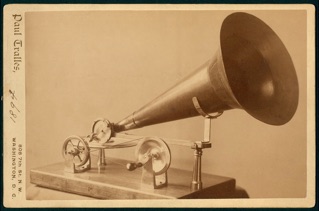
Early crank-handle Berliner Gramophone.
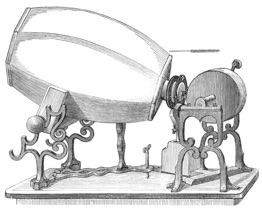
The Phonautograph.

